BOOB TUBE REVIEW
The new television season has begun--hip, hip . . . okay.
Do you get the feeling that every show coming on this year is a fourteenth-generation xerox copy of either Lost or CSI or 24? (I was also going to say Medium, but with Ghost Whisperer returning, it would be hard to know who's ripping off whom.) The ingredients of most of these clones seem much the same: large casts of pretty, buff-looking actors; vaguely out-of-this-world mysteries; and shows that pay morbid attention to equally morbid details. (I can't wait until the premiere of CSI:Boise.) It's as if the only way to get your show on the air is to present it as a hybrid of other shows, a new slant on the tried-and-true that, in truth, is not a new slant at all.
You can bet, for example, that since Hugh Laurie and House have made it alright for leading characters to be snarky, mean and unlikable, we'll have many unpleasant lawyers, cops, accountants and professors on the air--James Woods is already suiting up for Shark and Victor Garber is rumored to be an equally unpleasant lawyer on the Fox Network's Justice. (Or maybe he's just grumpy that ABC finally gave up on Alias.) It's nice that the arbitors of taste don't want to feed audiences pablum, but acid (as well as saccharine) should be used in small doses. What seems to be going over the network executives' collective heads is that it is specificity that audiences crave. It's not that every story must be new--there are, they say, only seven real storylines under the sun--but they have to be grounded in something connected and truthful. Hugh Laurie is at times a total bastard on House, but a) the man's in a lot of pain that he's trying to distract himself from, and b) it's refreshing to see a doctor as arrogant on TV as some of the real ones. Likewise, it is the first medical show in recent memory to show that doctors, however well-educated, are often shooting in the dark, hoping to hit the right diagnosis or, better yet, a cure. You actually see that they have to do some creative guess work, with risky and potentially deadly results. There are consequences to the decisions they make, and the results are not always good. Likewise, Medium succeeds not because of the mumbo-jumbo from the spirit world but because the show IS so grounded in real relationships--sweaty, messy, loving perhaps but at times testy. It truly would be a pain if your daily life were disrupted by these rather gruesome visions that ruined every night's sleep and spoiled the family dinner hour. (It also doesn't hurt that Medium's exemplary cast, led by Patricia Arquette and Jake Weber, have genuine chemistry and resemble real people.) One need only take a look at Jennifer Love Hewett's fake eye lashes, worn even in her sleep, to know that we're nowhere near any kind of reality. And no wonder we're a nation of sexually-confused people, when the hearty, dorky, stereotype locker room sexuality of CBS' Monday night lineup (Two and a Half Men, How I Met Your Mother) tells us that we are all a mess and that men and women will always behave badly, it's in the genes. (At least Yes, Dear is finally dead and buried.)
That said, here are a few quick comments about recently-viewed new offerings:
The Class (Mondays, 8pm, CBS) - Better than expected, with an attractive cast led by Jason Ritter and Jesse Tyler Ferguson, a script from one of the writers of Friends, and direction by the venerable James Burrows, looking for a new post-Will-and-Grace home. A 20-something tries to re-unite his third grade classmates to find out if they're still smiling or if they're as messed up as he is, with rather amusing results. Yes, it seems that the 20-somethings have nothing on their minds but sex and partying, but at least there's a genuine sense of longing here, laced with a range of different types of wit--for once, everyone in the ensemble contributes with different voices versus sounding like they all came out of a homogenous machine. The dating exploits of this mix-and-match group could get tiresome, but for now, there's some genuine sweetness and charm.
Men in Trees (Fridays, 9pm, ABC) Tough night on TV, but you've got to give ABC credit for trying something quirky opposite the detective dramas that rule Fridays. Anne Heche (yes, Ellen's ex, now straight again and a mommy) stars as a relationship counselor whose own romance hits the skids and ends up re-settling in Elmo, Alaska, where the men outnumber the women ten-to-one. In its attempts to figure out what makes men and women tick, it comes off as a particularly strange hybrid of Sex and the City meets Northern Exposure. Does everything have to be quite so cute and quaint? Still, Heche always has been talented despite her bizarre personal ups and downs, and she is surrounded by a cast that is charming in a back-burner way. (Abraham Benrubi is finally out from behind the ER desk and is actually fairly romantic--though not as Heche's love interest. They just had to get the spectacular-looking guy for that.) Still, there's a desire to sneak some truth in there, and if allowed to run for more than a couple of episodes (which the rumor mill says won't happen), this show may relax into a more a adult look at male-female relationships.
Standoff (Tuesdays, 9pm, FOX)- All right, Ron Livingston is a talent that's been waiting for a vehicle, but c'mon! Hostage negotiators, male and female, who are work partners and having a relationship while simultaneously talking down suicide bombers, kidnappers, crazy air traffic controllers and the like? Sorry, but there's nothing really cute about those situations, and tying them up with a bow is more than a bit disturbing. (The real test--we taped the second episode to watch but we just haven't gotten around to it, and I'm not sure we ever will.)
More to come over the next few weeks as the networks set their paper boats adrift. Which will float, which will sink, and which will take anchor? Tune in, TV addicts.
Monday, September 18, 2006


Saturday, September 16, 2006
RANTING TO MAKE A POINT
Okay, okay, I know punctuation is important.
(Even repeating the "okay," with commas after each "okay" in the previous sentence, makes the sentence read a certain way, both out loud and in our heads.)
 As a playwright and as a playwriting teacher, I feel that the biggest help you can give an actor (aside from the thoughts and the specific words to express those thoughts) is the punctuation that helps the actor plan their delivery and their breathing. It is equivalent of the stops, the rests, the pauses one finds in musical notation. Punctuation very often signals your intent in a subtle, psychological way, which is preferable and requires no deep-seated analysis (and is preferable to giving instructions for every single inflection, which insults the interpretive artist). The best writing always comes when we write as we speak--it's how we create the purest communication with the most "character." It's how we get our points across and, hopefully, keeps our readers/audience involved.
But . . . did you notice how, in the previous paragraph, I put the period inside the quotes when I tastefully decided to describe the colors writing takes on as its character? Or the comma after the first "okay" in the second paragraph? The laws decreed by the "Punctuation Police" say that anytime you have a quote followed by punctuation, the punctuation mark must go inside the closing quotation mark. Now, frankly, that is just plain dumb! While I believe that a quote of someone's speech should end with a period just inside the quotation mark, when you flag an item for its particular meaning--ie., its "raison-d'etre," if you will--why should you have to blend it back into the sentence when psychologically you want it to stand apart?! (See, I had to do it again with raison-d'etre!) I must protest! I think (and feel) that punctuation should reflect the author's intent in both psychology and in meaning, and the "grammar police" must learn to think outside the box when it comes to quotation marks. (After all, parentheses have a grown up attitude--when separated from part of a sentence, they surround the parenthetical thought but the punctuation goes OUTSIDE the end parenthesis . . . unless the entire sentence is a parenthetical thought, in which case the whole thing including the punctuation mark is sandwiched between the two slices of bread! Like this!) But when you use quotation marks as a "highlight," (see!) you aren't really allowed to make that highlight standout because the comma brings you careening back to the rules of the sentence! I say, "Stand up for your rights, writers! Vote to use your quotes as best suits your purpose!" (See, now that's the way it should work!)
And don't get me started on punctuating lists of three-or-more items, where some idiots like Lorraine Turabian (did I mispell her name? Tough!) insist on putting a comma after the next-to-last item before the "and," as in "planes, trains, and automobiles" versus "planes, trains and automobiles." It's enough to make you SCREAM!!!
On the other hand, I love elipses . . . !
This silliness was paid for by the Emmanuel Rant Society!
Okay, okay, I know punctuation is important.
(Even repeating the "okay," with commas after each "okay" in the previous sentence, makes the sentence read a certain way, both out loud and in our heads.)
 As a playwright and as a playwriting teacher, I feel that the biggest help you can give an actor (aside from the thoughts and the specific words to express those thoughts) is the punctuation that helps the actor plan their delivery and their breathing. It is equivalent of the stops, the rests, the pauses one finds in musical notation. Punctuation very often signals your intent in a subtle, psychological way, which is preferable and requires no deep-seated analysis (and is preferable to giving instructions for every single inflection, which insults the interpretive artist). The best writing always comes when we write as we speak--it's how we create the purest communication with the most "character." It's how we get our points across and, hopefully, keeps our readers/audience involved.
But . . . did you notice how, in the previous paragraph, I put the period inside the quotes when I tastefully decided to describe the colors writing takes on as its character? Or the comma after the first "okay" in the second paragraph? The laws decreed by the "Punctuation Police" say that anytime you have a quote followed by punctuation, the punctuation mark must go inside the closing quotation mark. Now, frankly, that is just plain dumb! While I believe that a quote of someone's speech should end with a period just inside the quotation mark, when you flag an item for its particular meaning--ie., its "raison-d'etre," if you will--why should you have to blend it back into the sentence when psychologically you want it to stand apart?! (See, I had to do it again with raison-d'etre!) I must protest! I think (and feel) that punctuation should reflect the author's intent in both psychology and in meaning, and the "grammar police" must learn to think outside the box when it comes to quotation marks. (After all, parentheses have a grown up attitude--when separated from part of a sentence, they surround the parenthetical thought but the punctuation goes OUTSIDE the end parenthesis . . . unless the entire sentence is a parenthetical thought, in which case the whole thing including the punctuation mark is sandwiched between the two slices of bread! Like this!) But when you use quotation marks as a "highlight," (see!) you aren't really allowed to make that highlight standout because the comma brings you careening back to the rules of the sentence! I say, "Stand up for your rights, writers! Vote to use your quotes as best suits your purpose!" (See, now that's the way it should work!)
And don't get me started on punctuating lists of three-or-more items, where some idiots like Lorraine Turabian (did I mispell her name? Tough!) insist on putting a comma after the next-to-last item before the "and," as in "planes, trains, and automobiles" versus "planes, trains and automobiles." It's enough to make you SCREAM!!!
On the other hand, I love elipses . . . !
This silliness was paid for by the Emmanuel Rant Society!
Tuesday, September 12, 2006

ON DISC
Some folks love show music. Some not. And some folks love Broadway voices, while others (like Simon Cowell) witheringly use the term when critiquing young "idol-wannabes." Of course, there are many diffent kinds of singers--Nat "King" Cole, Tony Bennett, Placido Domingo, James Taylor, Billy Joel, just to name a few. Who's to say one is a better singer than the other, given such a wide array of skills and vocal qualities? Crossover from one type of music to another is often tricky--obviously, not all voices have the ability to shift, and not all artistic temperments have the ability to excel in all styles. So while devoted Broadway fans have long admired the gifts of Brian Stokes Mitchell, whose rich, smokey baritone has moved audiences in such musicals as Ragtime, Kiss Me, Kate (Tony award), Kiss of the Spider Woman, Man of La Mancha and the recent TV concert version of South Pacific (opposite a perfectly-cast Reba McIntire), he is hardly a household name. (Sure, he was a regular in his youth on TV's Trapper John, M.D.,and played Frasier's snooty neighbor, Cal, but that's hardly going to get you recognized in Gary, Indiana.) Basically, he's been one of Broadway's hidden treasures, an authentic example of a great leading man. Still, it was quite a pleasant and startling surprise to find that his first solo album, self-titled Brian Stokes Mitchell, displays an amazing versatility: a voice that can go light, lyrical, big or bluesy. It's not some big voice trying to "get down," but rather, an authentic, connected sound with amazing assurance in any genre. The song list is not far off the Broadway path--most numbers are indeed of Broadway pedigree. But while Mitchell could easily have done them "straight" (as he is one of the best classic baritones around), the arrangements are mostly a mix of jazz and r&b, thoroughly fresh takes on old favorites. It is the amazing suppleness of Mitchell's work, beautifully shaded and phrased, that constantly takes one's breath away. Old standards yield brand new discoveries: one very clever hybrid features a mix of the Duke Ellington classic, "Take the 'A' Train," with Sondheim's "Another Hundred People" from Company, while West Side Story's "Something's Coming" (a song many a theater afficionado can sing in their sleep)becomes an actual and exciting promise--something really is likely to happen, maybe tonight! And the sensuous "Lazy Afternoon," from The Golden Apple, long a staple of the female repertoire (see Kaye Ballard and Barbra Streisand, for starters) becomes a hot, sinewy song of longing and seduction--and indisputably male. Mitchell has it all--the looks, the intelligence, the control and, apparently, an instrument that knows no bounds. The disc, which kicks off Playbill Records, is a treasure, but you don't have to love show music to appreciate it. You merely need to love good music, expertly sung. (Available at Playbill Online and at local record stores.)
Sunday, September 10, 2006
AT THE MOVIES
When the end-of-the-year award predictions come out, be prepared for The Illusionist to top many lists. Stunningly directed by Neil Burger, sumptuously photographed, and hypnotically scored (by Phillip Glass, no less!), it is both an elegant love story as well as an edge-of-your-seat mystery-thriller with special effects that dazzle but never overwhelm the dramatic intent of the story. A young boy falls in love with magic, and his street skills entrance an equally young duchess, who becomes his best friend. Since commoners cannot consort with royalty, they are separated by force. Years later, the now-grown boy (Edward Norton) emerges as Eisenheim the Illusionist, a master of seemingly impossible feats of magic that confound the imagination and suggest assistance from the Great Beyond. (Not surprisingly, if the boy can grow up to be Edward Norton, then the girl can grow up to be as lovely as Jessica Biel.) The Duchess Sophie is engaged to a pompous prig, who happens to be Crown Prince Leopold, played with a marvellously unhinged edge by the always-entertaining Rufus Sewell. The romance between childhood sweethearts is rekindled--until a violent action sets all asunder. All of this would be pretty, quaint, and only mildly involving were the story not told from the vantage point of Chief Inspector Uhl, a modest but highly-intelligent and magic-loving policeman played by uber-actor, Paul Giamatti. In a classic tale such as this, Uhl is the equivalent of Victor Hugo's Inspector Javert in Les Miserables, a man driven to find out not only the secrets to a magic trick, but to solve a case that he knows may cost him everything he holds dear. It's the type of role that in other hands could become fussy, farcical and hystrionic, but Giamatti underplays just the right amount, both vocally and physically (with a superb trace of Viennese accent), grounding the film and making his efforts to get to the truth totally believable. This is a taut 110 minutes of sheer enchantment, at once old-fashioned and yet enormously immediate. It will be fun to watch on the home screen, but best to see it in a theater, where its visual splendor and dark atmospheric pleasures can best be appreciated--and with no call-screening interruptions from your answering machine at a crucial moment! You'll want to watch this one in "real time." (Rated PG)
Also recommended: Little Miss Sunshine, a comedy definitely not-for-children, with an offbeat style and a superb ensemble cast featuring such dependable presences as Greg Kinnear, Toni Collette, Paul Dano, the great Alan Arkin and the ubiquitous Steve Carell (whose excellent performance clarifies just why he is so popular!). And Abigail Breslin is quite fine as the little girl who is the lynchpin of this dysfunctional family road picture. Add in an engaging (or should I say disengaging) performance by a VW bus and you have a comedic gem. Delightfully rude at times but never overbearing, directors Joanthan Dayton and Valerie Faris have made a truly fun film for adults that is sweet-natured but always tart to the taste. We've all had runs of bad luck--but few have been filmed as effectively and humorously as this! (Rated R)
When the end-of-the-year award predictions come out, be prepared for The Illusionist to top many lists. Stunningly directed by Neil Burger, sumptuously photographed, and hypnotically scored (by Phillip Glass, no less!), it is both an elegant love story as well as an edge-of-your-seat mystery-thriller with special effects that dazzle but never overwhelm the dramatic intent of the story. A young boy falls in love with magic, and his street skills entrance an equally young duchess, who becomes his best friend. Since commoners cannot consort with royalty, they are separated by force. Years later, the now-grown boy (Edward Norton) emerges as Eisenheim the Illusionist, a master of seemingly impossible feats of magic that confound the imagination and suggest assistance from the Great Beyond. (Not surprisingly, if the boy can grow up to be Edward Norton, then the girl can grow up to be as lovely as Jessica Biel.) The Duchess Sophie is engaged to a pompous prig, who happens to be Crown Prince Leopold, played with a marvellously unhinged edge by the always-entertaining Rufus Sewell. The romance between childhood sweethearts is rekindled--until a violent action sets all asunder. All of this would be pretty, quaint, and only mildly involving were the story not told from the vantage point of Chief Inspector Uhl, a modest but highly-intelligent and magic-loving policeman played by uber-actor, Paul Giamatti. In a classic tale such as this, Uhl is the equivalent of Victor Hugo's Inspector Javert in Les Miserables, a man driven to find out not only the secrets to a magic trick, but to solve a case that he knows may cost him everything he holds dear. It's the type of role that in other hands could become fussy, farcical and hystrionic, but Giamatti underplays just the right amount, both vocally and physically (with a superb trace of Viennese accent), grounding the film and making his efforts to get to the truth totally believable. This is a taut 110 minutes of sheer enchantment, at once old-fashioned and yet enormously immediate. It will be fun to watch on the home screen, but best to see it in a theater, where its visual splendor and dark atmospheric pleasures can best be appreciated--and with no call-screening interruptions from your answering machine at a crucial moment! You'll want to watch this one in "real time." (Rated PG)
Also recommended: Little Miss Sunshine, a comedy definitely not-for-children, with an offbeat style and a superb ensemble cast featuring such dependable presences as Greg Kinnear, Toni Collette, Paul Dano, the great Alan Arkin and the ubiquitous Steve Carell (whose excellent performance clarifies just why he is so popular!). And Abigail Breslin is quite fine as the little girl who is the lynchpin of this dysfunctional family road picture. Add in an engaging (or should I say disengaging) performance by a VW bus and you have a comedic gem. Delightfully rude at times but never overbearing, directors Joanthan Dayton and Valerie Faris have made a truly fun film for adults that is sweet-natured but always tart to the taste. We've all had runs of bad luck--but few have been filmed as effectively and humorously as this! (Rated R)
Saturday, September 09, 2006
THE NEWS FROM BROOKLYN
The summer weather has returned! It's hot, muggy and sticky in Park Slope today, a typical summer day. But it's comforting in an odd way: after all, Labor Day is only the "unofficial" end of the summer. Days like today remind us that the summer's not over yet! Life is not rushing by as quickly as feared, there's still time . . .
TODAY'S RECOMMENDATION:
If you're not familiar with the writer, Richard Grayson, you should be, especially those who love the short story form. Besides spending time on bogus runs for political office and publicity stunts that have graced People and Page Six in the Post, Grayson's been writing prolifically for years, and his first anthology, With Hitler in New York, was recently reissued. Other humorous writings have in cluded the collections I Break for Delmore Schwartz, Eating at Arby's: The South Florida Stories, and Narcissism and Me, as well as a novella, The Silicon Valley Diet. [Some of these stories have also been reprinted in Highly Irregular Stories (Dumbo Books).] But his recent collection, entitled And to Think That He Kissed Him on Lorimer Street, is perhaps the best collection to start with, reflecting not only his gifts as a satirist but his ability to keep the mind so busy it doesn't know that the heart has been touched. Like a reality TV junkie, Grayson mixes seeming fact with fiction, borrowing names, places and people from his own life and shaping them into odd and effecting commentaries on the passage of time, family relationships, sexuality, race relations, and America's pathological preoccupation with celebrity. Some stories are quick brushstroke sketches of people and a particular time. Others are journeys told in vignettes stretching spans of 20-30 years. Friendships are explored in sideways glances, showing how the most unlikely of alliances can turn into lifelong relationships. Numerous stories (perhaps one too many for the same collection) are subdivided by real estate locations: old movie palaces, libraries, and shopping centers, where seemingly innocuous events are recalled that by the end of the story add up to a whole lifetime of experience. Grayson shape shifts from gay to straight, white to black, male to female, kid to aging wit. Grandparents and childhood buddies play recurrent and important roles, but discerning fact from fiction in Grayson's work is tricky until one considers these stories in the aggregate. In the biography of the great Italian filmmaker, Federico Fellini, the maestro is quoted as saying that the truth of his life is not in the facts reported by birth certificates, death notices and journalistic reportage, but in his art, his dreams, his films--it is in the revelation of the imagination that the real artist is known. Likewise, the truth of Grayson is in these tales, invented and reinvented versions of his life and experience. The facts may not be verifiable, but the affection and care he displays in his description of life's travels and the people in his life are real, resulting in stories that are affecting and sharply observed. Recommended. (Available at www.lulu.com)
The summer weather has returned! It's hot, muggy and sticky in Park Slope today, a typical summer day. But it's comforting in an odd way: after all, Labor Day is only the "unofficial" end of the summer. Days like today remind us that the summer's not over yet! Life is not rushing by as quickly as feared, there's still time . . .
TODAY'S RECOMMENDATION:
If you're not familiar with the writer, Richard Grayson, you should be, especially those who love the short story form. Besides spending time on bogus runs for political office and publicity stunts that have graced People and Page Six in the Post, Grayson's been writing prolifically for years, and his first anthology, With Hitler in New York, was recently reissued. Other humorous writings have in
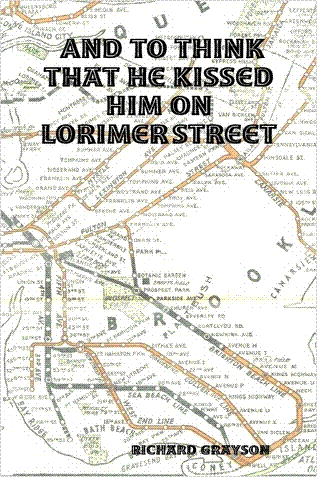 cluded the collections I Break for Delmore Schwartz, Eating at Arby's: The South Florida Stories, and Narcissism and Me, as well as a novella, The Silicon Valley Diet. [Some of these stories have also been reprinted in Highly Irregular Stories (Dumbo Books).] But his recent collection, entitled And to Think That He Kissed Him on Lorimer Street, is perhaps the best collection to start with, reflecting not only his gifts as a satirist but his ability to keep the mind so busy it doesn't know that the heart has been touched. Like a reality TV junkie, Grayson mixes seeming fact with fiction, borrowing names, places and people from his own life and shaping them into odd and effecting commentaries on the passage of time, family relationships, sexuality, race relations, and America's pathological preoccupation with celebrity. Some stories are quick brushstroke sketches of people and a particular time. Others are journeys told in vignettes stretching spans of 20-30 years. Friendships are explored in sideways glances, showing how the most unlikely of alliances can turn into lifelong relationships. Numerous stories (perhaps one too many for the same collection) are subdivided by real estate locations: old movie palaces, libraries, and shopping centers, where seemingly innocuous events are recalled that by the end of the story add up to a whole lifetime of experience. Grayson shape shifts from gay to straight, white to black, male to female, kid to aging wit. Grandparents and childhood buddies play recurrent and important roles, but discerning fact from fiction in Grayson's work is tricky until one considers these stories in the aggregate. In the biography of the great Italian filmmaker, Federico Fellini, the maestro is quoted as saying that the truth of his life is not in the facts reported by birth certificates, death notices and journalistic reportage, but in his art, his dreams, his films--it is in the revelation of the imagination that the real artist is known. Likewise, the truth of Grayson is in these tales, invented and reinvented versions of his life and experience. The facts may not be verifiable, but the affection and care he displays in his description of life's travels and the people in his life are real, resulting in stories that are affecting and sharply observed. Recommended. (Available at www.lulu.com)
Friday, September 08, 2006
If we are lucky, we get older, right? Consider the alternative . . . !
As we get older, we hopefully gain in experience. That doesn't mean we're any smarter or more gifted or more talented than our younger peers. It just means that we've seen things, done things, and have some experience we can share. Experience can be a valuable resource, a tool to scale ever greater heights.
Society seems all too ready to dispose of people once they've hit their middle years. (The French refer to middle age as "d'un certain age.") Sad, really, and wrong-headed--to dispose of or ignore those whose journey has taken them to so many interesting places. If life is just about end results--one giant reality TV series--then it loses its flavor. It becomes quick, clean, antisceptic. On the other hand, if it's about the gaining of experience, the journey, then life becomes an intriguing mystery, rich with detail, emotion, adventure.
Which would you rather have?
Obviously, this is a sensitive subject for me today. But isn't that what blogging is for?
As we get older, we hopefully gain in experience. That doesn't mean we're any smarter or more gifted or more talented than our younger peers. It just means that we've seen things, done things, and have some experience we can share. Experience can be a valuable resource, a tool to scale ever greater heights.
Society seems all too ready to dispose of people once they've hit their middle years. (The French refer to middle age as "d'un certain age.") Sad, really, and wrong-headed--to dispose of or ignore those whose journey has taken them to so many interesting places. If life is just about end results--one giant reality TV series--then it loses its flavor. It becomes quick, clean, antisceptic. On the other hand, if it's about the gaining of experience, the journey, then life becomes an intriguing mystery, rich with detail, emotion, adventure.
Which would you rather have?
Obviously, this is a sensitive subject for me today. But isn't that what blogging is for?
Thursday, September 07, 2006

Hi, World!
Can't believe I'm doing this, but I'm actually going to start publishing my thoughts online. Then again, life changes constantly--I'm doing many things I thought I'd never do, never want to do, never have to do. But life is primarily about change and how we ride and adjust to change. They say it's about the journey. Of course, I've always said that you don't want to find out the secret of life too soon, because then they have to kill you!
I've also always said I'd rather be a laughing fool than a crying idiot, since the laughers don't know they've lost it, they're just having a great time. So my apologies in advance to the nurses (male and female) in the convalescent home who have to endure my constant giggling and cackling--I won't know I'm being annoying, I'm just having a great time in my own little world.
Hell, if Rosie O'Donnell can have a blog, so can I!
I promise I'll try to keep this interesting. I'll write reviews of things I've read or seen, and I'll tell you about projects my friends and I are working on. And of course, you can always go to my web site, (which is http://juddls.home.sprynet.com, but you can just click on the words web site.)
On the good news front, EDDIE HAS ALLERGIES is out! Published by Ernest Silliman Books and Lulu, it's my kids book about the fantasies and misadventures of a young boy with allergies, how
the various stuffy noses and medications produce majorly wierd
 fantasies, and how he learns that what isolates him also makes him unique--and contributes to the person he ultimately grows up to be! (Gee, who does that remind me of?) It's fun, it's funny, and hopefully it's a book that will tell kids it's okay to be different. It's available directly from the publisher, Ernest Silliman Books and Lulu, as well as online from Amazon, Barnes & Noble, Borders, and numerous smaller online bookstores. (You can also order it from a bookstore, where hopefully if they order one for you, they'll keep a few on the shelf as well, so thanks. The ISBN number is 1847287115).
For the third season, Playwrights for Pets, will present evenings of plays to raise funds for Animal Haven. The group, founded by Sue Yocum, raises money to help provide food, shelter, leashes, etc., for animals in need in the NYC area. (We also raised a sizeable chunk of money last season for animal victims of Hurrican Katrina, which allowed Animal Haven to rescue and find homes for the orphaned animals.) On October 30th, our first event will be
 MISCHIEF NIGHT, an evening of twisted tales by wonderful playwrights and read by even more wonderful actors. The evening of readings will start at 7:30 and the suggested donation is $10. We will once again be in the beautiful basement space at the Baruch Center for the Performing Arts (BPAC), which is at 55 Lexington Avenue (Lex & 25th).
Final weeks to sign up for my Adult Playwriting class at the Abrons Arts Center at Henry Street Settlement. The class starts September 20th and meets on Wednesday nights from 7-9 pm. Ten weeks are only $150. In addition to reading and critiquing members' work, we will discuss the creative process, writers block, play marketing and, well, life. Call 212-598-0400, ext. 224 to register, or go to the Henry Street Settlement Web Site.

My friend Barry Steely's latest art can be seen online at the website, www.artistsspace.org.
That's all for today!
Subscribe to:
Posts (Atom)